HRM is continuing its ‘public consultation’ on the Halifax Common draft plan via an on-line survey or comments until February 28, 2023. Thanks to Mayor Savage and HRM Council supporting HRM’s Community Economic Development standing
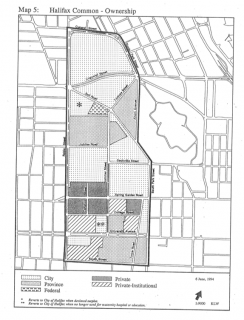
The Halifax Common grant in 1763 was for 235 acres ” to and for the use of the inhabitants of the town of Halifax as Common, forever.” This entire area was to be considered for planning purposes in the 1994 Halifax Common Plan.
committee’s excellent recommendation in January 2022 to bring it back to the public for feedback. (view video of committee meeting)
This plan is critical to the future of the Halifax Common. That’s why we want HRM staff to do more than an online survey or emailed comments. That’s no substitute for public presentations and engagement. We are also very concerned that HRM has not consulted with the public about the Wanderers Block and that it is engaging in side deals.
Below are draft notes you can use to help you to write more detailed comments to HRM. Please email commonplan@halifax.ca to ask for actual public presentation(s) of the revised document followed with opportunities for public feedback. And to also ask that there be public consultation on the Wanderers Block.
We’ve identified four themes we believe are most important based on what the public asked for. Each of these themes has a section under concerns and then feedback to HRM staff.
Themes
1. Protect the Whole Halifax Common, both public and private, with legislative policies and protection
2. Plan For the Whole Halifax Common & Reclaiming and Expanding Public Leisure Space
3. Respect the Public’s Role in Shaping the Common
4. Draft Plan is 500pp with a Vision, Purpose, Policy Process; it needs Public Presentation & Consultation (along with executive summary, timelines, budgets and many details)
Please do a quick scan or deep dive and then either:
1. email your Feedback directly to: commonplan@halifax.ca
For example: ask that there be an actual public presentation(s) of the document followed with opportunities for feedback not just an on-line survey.
or…
2. complete an HRM online survey found here.
Remember the sections in green below under feedback are the quickest way to help with ideas on how to make the plan better
Themes, concerns, feedback
a. The Halifax Common Master Plan must include policies and protection for the entire Halifax Common. This is urgent. We cannot support a plan that does not undertake immediate action towards this protection and preservation of all open publicly accessible land.
b. Amend the HRM Charter via the provincial Legislature to define what Council is permitted to do with the Common, and what processes to follow. There are already such provisions in the HRM Charter regarding the Dartmouth Common.
c. Incorporate all of the final Common Plan into the Municipal Planning Strategy. This would be a useful step, but one HRM Council could adjust after a public hearing. Its efficacy is that any planning decisions affecting the Common would need to accord with what is in the MPS, and some decisions could be appealed to the UARB and tested by that standard.
d. Consider creating a ‘board of trustees’ established specifically for the Common, with a requirement for Council not to make decisions about the Common without consulting the trustees; or the trustees could be the entity empowered to make the decisions. Such boards are potentially useful, but much would turn on the specifics of their mandate, and the composition of the board. These specifics and the board composition and time frame for serving on the board should be vetted by the public.
e. Clarify details on designation of the Halifax Common as a cultural landscape.
2. FHC concerns:
a. Be Bold! This Plan replaces the 1994 Master Plan, and so it must be a Plan for the entire Halifax Common as per the 1994 Plan and confirmed, supported, emphasized in more recent public consultations. And again as per the 1994 plan this document must take action to keep, re-capture and not give up further lands on the Halifax Common.
b. The Plan needs clear language that gives direction. While not everything can be covered by a definite statement, there are many things that can be action items with definite outcomes. For example there over 80 actions but there is no real direction for specific outcomes.
c. Support the Policy Direction and give actions to preserve and reclaim the Halifax Common within a cohesive Common District including MOU with Capital Health and land use planning regulations. Include steps to:
d. Municipal Open Space Management…protection…retention / enhancement / connected spaces / Plan to expand the green space within and beyond the exiting Common, for example including the Centennial Pool grounds and green routes to the Halifax Harbour, the NW Arm, Point Pleasant Park and Africville.
e. Keep land use as per original intent of Halifax Common being for all inhabitants. This needs better balance.
a. Include the entire Wanderers Block in the Public Consultation – stop the side deals. This is a significant area of land that requires transparent, public and open process and must come back to the public.
b. Return the Wanderers Field to amateur players as per the 2017 staff report; move the private stadium to a better location; drop the language about a premiere sports venue
c. Move the HRM Storage Depot asap (as per the 1994 Plan and recent public input)
d. Develop policies specific to the Halifax Common for corporate sponsorship, advertising, public art, lighting. The objectives should be to retain, regain the sense of a cohesive space with the least amount of signage, installation or infrastructure.
4. Theme: Draft Plan: Plan = Vision, Purpose, Policy Process needs Public Presentation & Consultation (along with executive summary, timelines, budgets and many details)
a. There needs to be an actual public presentation(s) of the document followed with public engagement / feedback not just an on-line survey.
b. If the Plan is to be understood by the public, staff and Council it needs to be condensed and tightened. It requires an executive summary. It need clear language with less jargon and less verbiage. There must be a better synthesis of the purpose of the document, its specific goals, objectives, outcomes and deliverables with a timeline. These should clearly connect the public consultation key findings with the Guiding Principles and Policy Directions. While attractive in its layout the document is thin on how it will lead to outcomes.
For comparison see the current new Boston Common Master Plan [PDF].
c. The document needs to have a stated review time frame (3-5 years) for when the Plan returns to the public for re-evaluation and input.
d. The document needs to propose priorities (i.e. for deciding improvement or changes) and how these are to be established
e. The document needs to have suggested budget lines.
f. Community Standing Committees could work on specific policy gaps (public art policy, lighting, noise, green network). Many experienced citizens could engage if they felt their input mattered.
g. As per FHC’s first Theme, the Plan must not only identify long-term land-use strategies it must address protection and identify a way for desired land-use strategies to be codified as policy and basis for all future decisions.



We care about your privacy. FHC does not share user data.
FHC maintains a membership list and an email list for purposes of delivering news and updates. You can unsubscribe at any time.
This site does not use cookies.